
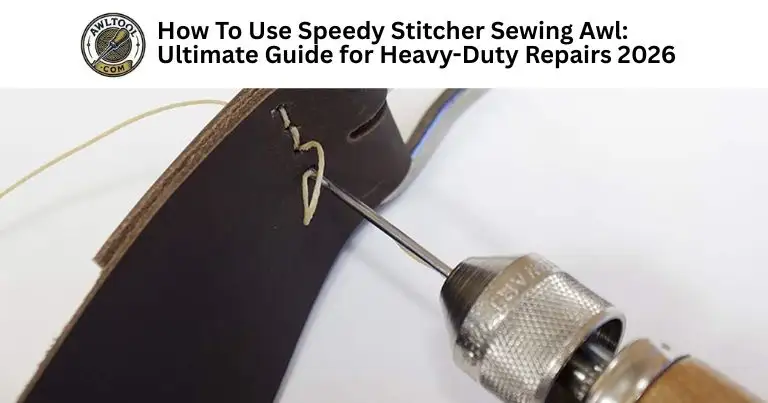
To use a Speedy Stitcher Sewing Awl, start by threading the waxed thread from the internal bobbin through the handle and needle eye. Push the needle through your material, pull a thread loop through, and extend it to the length of your seam.
For each subsequent stitch, push the needle through, pass the free thread through the resulting loop, and pull tight to create a durable lock stitch.
Table of Contents
Introduction to the Speedy Stitcher Sewing Awl
Whether you are a professional leather crafter in Texas or a DIY enthusiast fixing a boat cover in Florida, the Speedy Stitcher is an essential tool. It allows you to perform industrial-strength repairs without needing a heavy sewing machine.
This manual hand tool creates a “lock stitch”, the same sturdy stitch used by machines, making it perfect for leather, canvas, and thick webbing.1
In this guide, we will break down exactly how to use Speedy Stitcher Sewing Awl tools to achieve professional results. Check our latest Speedy Stitcher Sewing Awl Repair Tool Kit Review to ensure you have the most up-to-date techniques.
What’s Inside the Speedy Stitcher Kit?
Before we dive into the how-to, let’s look at what comes in a standard kit from reputable sources like AwlTool.com:
- The Wooden Handle: Contoured for a comfortable grip and hollowed out to store the thread bobbin.
- The Threaded Post & Chuck: This holds the needle in place.
- Needles: Usually includes one straight needle and one curved needle.
- Waxed Thread: High-tensile thread pre-wound on a bobbin.2
- Tension Post: A small metal pin on the handle used to control thread flow.
Step-by-Step: How To Use Speedy Stitcher Sewing Awl
1. Setting Up and Threading the Awl
The first step in mastering how to use a sewing awl on canvas or leather is proper threading.
- Access the Bobbin: Remove the end cap from the wooden handle. You’ll find a pre-installed bobbin of waxed thread.
- Route the Thread: Feed the thread through the small hole at the bottom of the handle, then guide it along the groove on the outside of the handle toward the needle end.
- The Tension Post: Loop the thread once around the tension post (it looks like a small tack). This ensures your stitches stay tight and even.
- Install the Needle: Choose your needle (the straight needle is most common for beginners). Notice the groove on the needle; align this groove with the thread post.
- Final Threading: Pass the thread through the eye of the needle from the grooved side. Place the needle into the threaded post, ensure the thread is running freely through the chuck’s opening, and tighten the chuck firmly by hand.
2. Starting Your First Stitch
To begin, push the needle completely through your material.
- Pro Tip: If you are working on thick leather, refer to our guide on Mastering Edge Leather Stitching Techniques for USA Crafters 2025. It recommends pre-punching holes with a diamond awl or a stitch punch to make the process easier and save your hands from fatigue.
Once the needle is through, pull out enough thread to cover the entire length of the seam you plan to sew, plus about 3–5 extra inches for finishing. Pull the needle back out, leaving that long “tail” of thread on the bottom side of the material.
3. Creating the Lock Stitch
This is the core of how to use Speedy Stitcher Sewing Awl mechanics:
- Insert the Needle: Move forward one stitch length and push the needle through the material again.
- Form the Loop: Pull the needle back slightly (about half an inch). This creates a small loop of thread on the underside of the needle.
- Pass the Thread: Take the long “tail” of thread (from the bottom side) and pass it completely through that loop.
- Tighten: Pull the needle all the way out of the hole while holding the bottom thread. Pull both ends firmly so the “knot” (the lock) is buried in the middle of the fabric layers.
4. Finishing the Seam
When you reach the end of your project:
- Push the needle through one last time and pull a loop out.
- Cut the thread near the needle eye.
- You will now have two loose ends on the bottom side.
- Tie a double overhand knot.
- The Mushroom Head Technique: For synthetic waxed thread, cut the ends short and use a lighter or a hot knife to melt the tips. Press the melted wax with your finger to create a “mushroom head” that prevents the knot from ever pulling through.
What Projects Is the Speedy Stitcher Awl Best For? Outdoor & Leather Fixes
The versatility of this tool is unmatched. Here are the most common USA-based projects:
- Leather Goods: Repairing saddles, holsters, belts, and knife sheaths.3
- Marine & Auto: Fixing Sunbrella boat covers, convertible tops, and torn upholstery.
- Camping Gear: Patching tents, backpacks, and heavy-duty tarps.4
- Webbing: Repairing straps on luggage or outdoor equipment.
| Material | Pre-Punching Needed? | Recommended Needle |
| Thin Canvas | No | Straight Fine |
| Heavy Leather | Yes | Straight Heavy |
| Sunbrella/Marine | No | Straight Heavy |
| Nylon Webbing | No | Straight Heavy |
Pro Tips for Success
- Keep the Groove Up: For the best looking stitches, keep the needle’s groove facing “up” or at a right angle to your stitch line. This makes the loop easier to catch on the underside.
- Basting Webbing: If you are sewing webbing, use staples or a bit of double-sided tape to hold the layers together. This prevents the layers from shifting and keeps your “Box X” stitches perfectly straight.
- Tension is Key: If your stitches look loopy on top, you aren’t pulling the bottom thread tight enough. If they look loopy on the bottom, your tension post isn’t threaded correctly.
Frequently Asked Questions (FAQ)
What is a Speedy Stitcher used for?
It is a hand-held tool used to create a heavy-duty lock stitch in thick materials like leather, canvas, and denim.5 It is primarily used for repairs where a standard sewing machine cannot reach or lacks the power to penetrate the material.
How to use an awl on fabric?
Unlike leather, fabric usually doesn’t require pre-punched holes. Simply mark your stitch line with chalk, push the awl through the fabric layers, and follow the lock-stitch process. It is excellent for repairing outdoor furniture and sails.6
Can a sewing awl be used for shoe repair?
Yes! It is one of the most popular tools for DIY shoe repair. It can stitch through rubber soles and thick leather uppers, making it perfect for fixing work boots or hiking shoes.7
Is it actually cheaper to sew your own clothes?
For everyday fashion, typically no. However, for high-end leather gear or specialized outdoor equipment, DIY sewing with a Speedy Stitcher can save you hundreds of dollars in professional repair costs or replacement fees.
Is sewing harder than crocheting?
They require different skill sets. Crocheting is often considered more “forgiving” because you can easily undo stitches.8 Sewing with an awl is more physical and requires precision, but it is faster for functional repairs.
Conclusion
Learning how to use Speedy Stitcher Sewing Awl tools is a “buy-it-for-life” skill. Whether you are following a Speedy Stitcher Instructions PDF or watching a how to use speedy stitcher sewing awl youtube video, the key is practice. Start on scrap pieces of canvas before moving to your expensive leather projects.
By mastering the lock stitch and the “mushroom head” finishing technique, you’ll be able to repair gear that most people would throw away.
Ready to start your next project? Check out our deep dive into Select What Projects Is the Speedy Stitcher Awl Best For? Outdoor & Leather Fixes to get inspired!
Join the Community on Instagram and Facebook: Share your favorite marking or drilling tools and tag us to get featured!
Best Awl tools Short lists by job categories:
- Starter sets for awl tools
- Top-rated woodworking awls
- Top leather stitching awls
- Must-have bookbinding awls
- Buy high-quality awls
- Comprehensive guide to awl types
- Unique Applications (Carpet awl, Plastic, Bone)

Hi, I’m Nicholas N. Goforth, a New Mexico crafter with 20 years of experience in leatherworking, woodworking, and bookbinding.
Inspired by a Santa Fe market, I turned my passion into AwlTool.com, launched in 2025, to share tutorials and handcrafted goods.

