
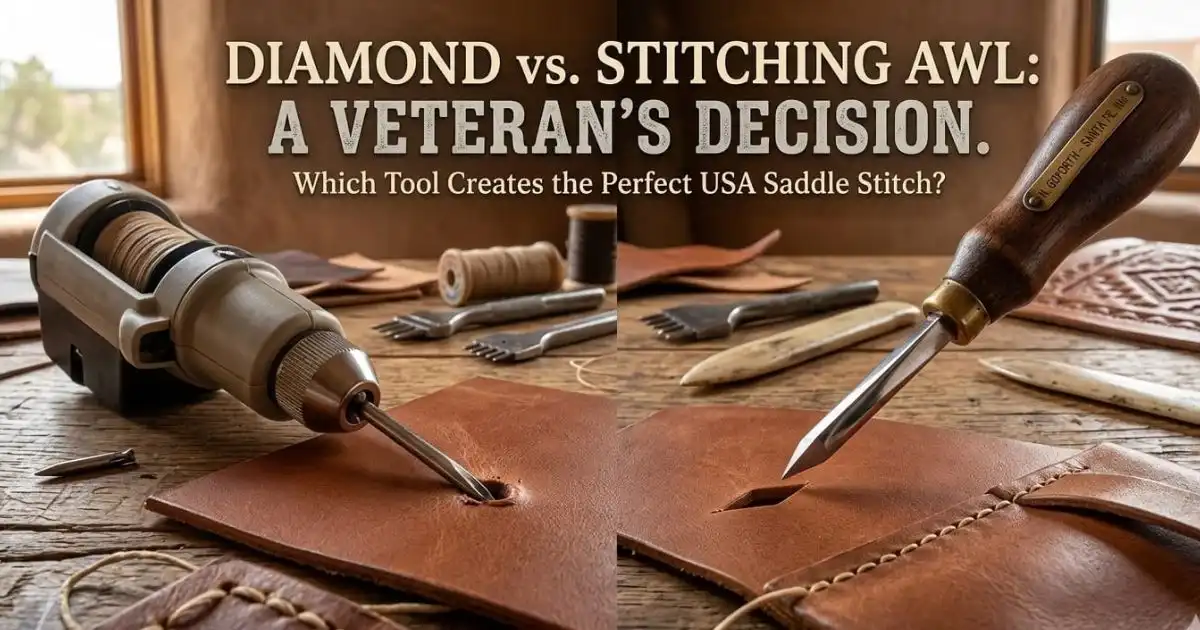
The wrong awl will ruin your leather project before you make a single stitch. Most beginners don’t realize this until they’re staring at a $50 piece of vegetable-tanned leather with ugly, crooked holes they can’t fix.
Choosing between a diamond awl and a stitching awl is the #1 mistake new leathercrafters make. Pick the wrong one, and you get a stair-step stitch on the front and a complete mess on the back. Pick the right one, and your saddle stitch looks like it came from a professional shop.
This guide breaks down the real difference, blade geometry, project fit, and when to use each tool, so you spend your money once and get it right.
Let’s get into it.
By Nicholas N. Goforth, 20-year leatherworker based in New Mexico, regular at the Santa Fe Leather Market.
Table of Contents
What Is the Difference Between a Diamond Awl and a Round Awl?
Short answer: A round awl marks and punctures. A diamond awl cuts a precise slit that holds thread correctly. They are not interchangeable.
Here’s the geometry that matters:
A round awl has a tapered, circular tip. It pushes the leather fibers apart as it punches through. The hole it makes is round.
When you pull the awl out, leather fiber memory tries to close the hole back up. That’s the “self-healing” problem. Your thread fights the leather every time you pull through.
A diamond awl (also called a 4-sided blade awl) has four cutting edges. It doesn’t push fibers, it slices them into a clean, diamond-shaped slit.
The slit stays open. The needle passes through easily. The thread lays flat inside the leather, not on top of it.
That’s the invisible difference that separates a polished saddle stitch from a lumpy, amateur-looking seam.
I learned this the hard way. Back in 2006, I was standing at a vendor booth in Santa Fe. I had a cheap round awl and jagged stitches I couldn’t explain. An old saddlemaker looked at my work, picked up my tool, and handed me a diamond blade. He said, “Son, you’re trying to push a round peg into a square hole.” I bought a diamond awl that afternoon. I still use it today.
The back-stitching “double stitch” look that Reddit’s r/Leathercraft community complains about? Nine times out of ten, that’s a round awl problem.
The thread has no clean channel, so it twists instead of sitting flat. If your stitching looks great on the front but uneven on the back, switch to a diamond awl first.
Key takeaway: Use a round awl for marking, transferring patterns, and general hole-punching tasks. Use a diamond awl for any project that requires a finished, professional saddle stitch.
When to Use a Stitching Awl vs. a Diamond Awl?
This is where project type matters more than personal preference.
The Stitching Awl (Automatic / Speedy Stitcher Style)
An automatic stitching awl, like the Speedy Stitcher sewing awl, holds a spool of waxed thread inside the handle.
You push the needle through the leather, a loop forms underneath, and you lock it with each push. It’s fast. It’s strong. It’s designed for thick, heavy-duty work.
Best projects for a stitching awl:
- Horse saddles and tack
- Heavy belts (over 8–10 oz leather)
- Canvas and webbing repair
- Boot and shoe repair
- Camping gear and pack straps
The Speedy Stitcher Trap: This tool is heavily marketed to beginners. But for fine leatherwork, wallets, watch straps, card holders, it’s too much tool.
The needle is thick. The stitch pattern is a lock stitch, not a saddle stitch. On thin leather (2–4 oz), it tears the fibers and creates a raised, ugly seam. I once used a standard automatic stitching awl on a custom holster.
The seam was so bulky it wouldn’t fit properly around the trigger guard. I scrapped $50 of leather because I used the wrong tool.
For a full breakdown of when the Speedy Stitcher actually shines, check the Speedy Stitcher Sewing Awl Repair Tool Kit Review.
The Diamond Awl (Hand Sewing Style)
A diamond awl is used in traditional hand saddle stitching. You pierce each hole individually, then pass two needles from opposite sides. The result is a true saddle stitch, the strongest hand stitch in leatherworking.
Best projects for a diamond awl:
- Wallets and bifolds (2–5 oz leather)
- Watch straps
- Card holders
- Fine knife sheaths
- Custom holsters with tight tolerances
- Any luxury goods project
Simple rule: If your project is thick and rugged, use a stitching awl. If your project is thin and precise, use a diamond awl.
Can I Use Diamond Chisels Instead of an Awl?
Yes, and in 2026, many leathercrafters are using both. Here’s how to think about it.
| Feature | Diamond Chisel | Diamond Awl |
|---|---|---|
| Speed | Fast (marks multiple holes at once) | Slow (one hole at a time) |
| Precision | High on flat surfaces | High everywhere, including corners |
| Skill floor | Low | Medium |
| Best use | Straight stitch lines | Curved edges, corners, thick gussets |
| Hole shape | Consistent slit spacing | Manually controlled depth |
The 2026 update the Reddit forums want: Chisels and awls are not competitors. They’re partners.
Use a French pricking iron or diamond chisel to mark your stitch line and set your spacing (typically 9–12 SPI for fine work). Then use your diamond awl to individually open each marked hole as you stitch. This gives you perfect spacing and the cleanest possible slit for thread passage.
On thick, multi-layer gussets, the kind on a bifold wallet or a saddlebag, a chisel won’t punch clean through multiple layers cleanly. That’s where a sharp diamond awl does the work chisels can’t.
For beginners wanting to understand which tool to start with, the guide on awl tool kits for beginners covers starter setups that include both.
What Is the Difference Between a French Awl and a Diamond Awl?
Both cut slits. Both are used for saddle stitching. The difference is blade profile, and it matters for luxury-grade work.
A diamond awl has a symmetrical 4-sided point. The cross-section is a true rhombus. It creates a balanced slit that works for most leather weights (3 oz to 12 oz) and most thread thicknesses.
A French awl (sometimes called a saddler’s awl or bridle awl) has a slightly flattened, asymmetrical profile. The blade is wider and thinner, more like a flat oval than a diamond. The slit it creates is elongated and lies perfectly parallel to the stitch line.
Why does that matter?
At fine SPI settings (10–12 stitches per inch), a standard diamond awl slit can look slightly “open” between stitches. A French awl’s elongated cut closes more tightly around the thread, giving a cleaner surface finish. That’s why French awls dominate in Hermès-style luxury stitching and shell cordovan work.
Thread pairing matters too. For diamond awl work, use 0.8mm–1.0mm polyester or linen thread. For French awl fine work, drop to 0.6mm–0.8mm. The thread should fill the slit without stretching it.
If you work with premium materials like Horween or Wickett & Craig leather, the French awl’s profile prevents the “open stitch” look that can appear on tightly grained, high-end hides.
For a full comparison of types of awls and their uses, the breakdown covers every blade profile from scratch awls to curved awls and when each earns its place in your kit.
5 Pro Tips for Using Your First Diamond Awl (Without Stabbing Yourself)
After 20 years of teaching leathercrafting in New Mexico, these are the five things I wish every beginner knew on day one.
1. Sharpen It Before You Touch Leather
A factory-sharp awl is not sharp enough. I’m serious. Take a leather strop loaded with green compound and run your awl blade across it 20–30 times per side before the first use. The test? Drag it lightly across your thumbnail. It should catch, not slide.
The Blood-Stain Rule: If your awl doesn’t glide through leather, you’re going to push harder. Push harder, the awl slips. Slips means the tip goes into your palm. A sharp awl is a safe awl. A dull awl is an emergency room story.
For the full sharpening method, see how to sharpen an awl.
2. Listen for the Pop
A perfectly sharp diamond awl punching through properly prepared leather makes a clean, quiet pop as the tip clears the back side. If you hear a ripping sound, your awl is dull. If you hear nothing and feel resistance, you’re pushing at the wrong angle or the leather is too dry.
3. Angle Your Awl Consistently at 90°
Beginners tilt the awl slightly as they push. Even a 5-degree tilt changes the slit angle. After 20 holes, you have a stitch line that curves. Use an awl guide or draw a pencil line on the edge of your leather and keep the blade parallel to it.
4. High-Desert Leather Maintenance (And Handle Care)
If you’re crafting in dry climates, New Mexico, Arizona, Colorado, your wooden awl handle will crack without care. Rub a light coat of beeswax or raw linseed oil into the handle every 3–4 months. It takes 2 minutes. It saves the handle from splitting and keeps your grip secure.
The same dry air affects your leather. Condition vegetable-tanned leather with neatsfoot oil before working it in winter months. Dry leather tears instead of accepting a clean cut.
5. Don’t Skip the Backstitch at the Start and End
Every stitch line needs to be locked at both ends. Pass your needle back through the last 2–3 holes before cutting your thread. This prevents unraveling under stress, especially critical on belts, holsters, and straps.
For a full library of hand-stitching technique guides, the leather stitching techniques for beginners page walks you through every step with visuals.
Hand-Forged vs. Factory Awl: Is the $150 Price Tag Worth It?
You’ll see hand-forged diamond awls from artisan makers, Doldokki, Ron’s Tools, Nigel Armitage-style small-batch makers, priced at $80–$200. Are they worth it for a beginner?
My honest answer: No. Not yet.
A quality factory-made diamond awl from a reputable brand in the $25–$45 range will do everything you need for your first 18 months of leatherwork. See the best awl tool sets for leatherworking for vetted starter options.
After 18 months, you’ll know exactly what you want from a blade, handle weight, blade length, tip geometry. Then spend the money on a hand-forged awl. It will last decades. Mine has.
The heirloom factor is real. The diamond awl I bought in Santa Fe 20 years ago has better steel than 90% of what’s sold online today. I’ve re-handled it twice.
The blade itself has never failed. That’s the value of a quality tool, not that it’s expensive, but that it outlasts everything cheap by a factor of ten.
Frequently Asked Questions
What is a diamond awl used for in leatherworking?
A diamond awl is used to pierce clean, slit-shaped holes in leather for saddle stitching. Its 4-sided blade cuts through leather fibers instead of pushing them apart, creating a slit that holds thread neatly and produces a flat, professional-looking stitch.
What is the difference between a scratch awl and a stitching awl?
A scratch awl has a round, tapered point used for marking lines, scoring surfaces, and transferring patterns. A stitching awl has a bladed tip (often diamond-shaped) designed to punch holes for thread. They serve completely different purposes, scratching vs. sewing. See what kind of tools are center punch and scratch awl for a deeper comparison.
Can I use a stitching awl on thin leather like a wallet?
Not recommended. Automatic stitching awls (like the Speedy Stitcher) use thick needles and create a lock stitch. On thin leather (2–4 oz), this tears fibers and creates a stiff, raised seam. Use a fine diamond awl instead for wallets, card holders, and watch straps.
What is the best awl for saddle stitching by hand?
A diamond awl with a blade length of 40–50mm is the standard choice for saddle stitching. Pair it with a French pricking iron to pre-mark your stitch spacing, and use 0.8mm polyester or linen thread. See leather stitching techniques by hand for the full method.
How do I know if my awl is sharp enough to use?
Run the tip lightly across your thumbnail at a low angle. A sharp awl will catch slightly on the nail surface. A dull awl will slide off. For leather, a properly sharp awl should pierce 4 oz veg-tan leather with firm, controlled pressure, no forcing, no wobbling. If you’re forcing it, stop and strop it.
Final Verdict: Diamond Awl vs. Stitching Awl
| VS. | Diamond Awl | Stitching Awl |
|---|---|---|
| Best for | Wallets, straps, fine goods | Belts, saddles, heavy repairs |
| Leather weight | 2–8 oz | 8–16 oz |
| Stitch type | True saddle stitch | Lock stitch |
| Skill required | Medium | Low |
| Price range | $20–$200 | $15–$60 |
| Beginner friendly? | Yes, with practice | Yes, for heavy work |
If you’re serious about hand-stitched leather goods that look clean on both sides, a diamond awl is the tool you need. A stitching awl has its place, but it’s not a substitute for real saddle stitching technique.
Start with a mid-range diamond awl. Strop it before use. Practice your angle. Listen for the pop. Your leather will thank you, and so will everyone who picks up your finished work and wonders how you made something that looks that good.
Nicholas N. Goforth is a 20-year leatherworking craftsman based in New Mexico. He has taught leather stitching workshops at regional craft fairs including the Santa Fe Leather Market. All tool recommendations on AwlTool.com are based on hands-on testing and personal use.
Join the Community on Instagram, Facebook & YouTube: Share your favorite marking or drilling tools and tag us to get featured.

